

Operational downtime does not require a targeted cyberattack to bring an organization to a complete standstill. While ransomware and corporate data breaches dominate the media, small and medium-sized businesses (SMBs) face an equally destructive and far more common vulnerability: unexpected infrastructure failures across their third-party cloud and software dependencies.
Modern SMBs run on centralized Software-as-a-Service (SaaS) applications, remote productivity suites, and digital transaction networks. When an upstream provider experiences a configuration error, a routine update bug, or network routing failures, dependent organizations suffer immediate operational paralysis. Without structured safeguards, a single software disruption cascades into lost revenue, compromised client retention, and contractual liabilities.
Understanding what is an IT disaster recovery plan and integrating it into an organization-wide business continuity posture is the baseline requirement for operating in a centralized digital economy.
Why is business continuity planning essential for surviving modern cloud and software outages?
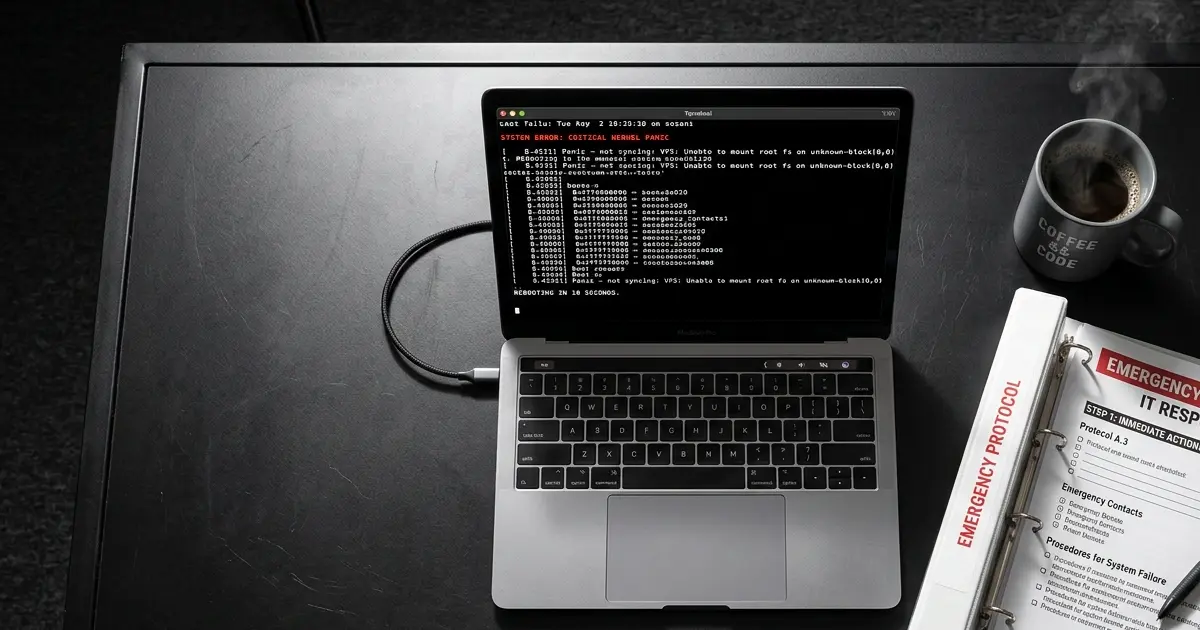
Business continuity planning is an operational framework designed to ensure that an organization’s critical business functions persist or pivot rapidly during an unexpected operational emergency. Unlike a narrow technical data restore, continuity planning addresses operational workflows, personnel safety, supply chain dependencies, vendor management, and continuous cash flow.
Many SMB leadership teams operate under the assumption that moving files to the cloud removes the need for business continuity. In reality, moving operations to external platforms merely trades physical hardware failure for cloud dependency risk. True operational resilience requires documented manual workarounds and alternative communication channels that function independently of central cloud ecosystems.
The Failure of Cloud Monocultures: Real-World Outage Precedents
Recent enterprise disruptions demonstrate how dependent small and mid-sized organizations suffer when central software rails collapse:
- Microsoft Ecosystem Service Interruptions: A global software disruption across the Microsoft ecosystem directly impacted mission-critical collaboration and operational applications—including Microsoft Outlook, Teams, and Copilot—across more than 70 countries. The microsoft outage business impact was immediate for SMBs relying entirely on a single ecosystem for email, internal chat, document collaboration, and Entra ID identity management. Organizations without alternative communication channels faced an immediate blackout, halting client meetings, invoice processing, and project management pipelines.
- Zelle Banking and Payment Network Glitches: When payment processing glitches impacted financial institutions using the Zelle network, end users suffered delayed settlements, payment failures, and account access disruptions. While the core settlement network maintained technical uptime, integration breakdowns between partner institutions froze transactional cash flows. Small service businesses and merchants depending solely on peer-to-peer or single-rail digital transfers found themselves unable to clear accounts receivable, compensate hourly contractors, or confirm real-time transactions.
- United Airlines Operational Pipeline Outages: A software failure within internal flight dispatch and operations systems forced United Airlines to ground and delay flights nationwide. The incident revealed how modern, automated operational pipelines offer zero tolerance for system errors. For SMBs operating with automated dispatching, inventory control, or centralized CRM platforms, software failure immediately halts deliverables unless staff can execute pre-configured manual overrides.
Establishing Manual Workarounds and Out-of-Band Communications
Surviving these incidents requires establishing non-digital and decoupled operational workflows before an outage occurs:
- Paper-Trail and Offline Protocols: When primary point-of-sale (POS) systems, scheduling dashboards, or billing platforms drop offline, personnel must have immediate access to standardized, physical operational binders. These protocols include pre-printed order forms, offline transaction authorization thresholds, and manual dispatch logs.
- Out-of-Band Communication Channels: When default internal messaging and VoIP systems fail, organizations cannot coordinate incident response through their primary channels. Continuity planning requires pre-configured, independent communication channels—such as external SMS broadcast trees, cellular bridges, and dedicated off-network status pages accessible to personnel securing remote perimeters.
- Eliminating Operational Single Points of Failure: Relying on single-threaded architectures introduces massive organizational vulnerability. Bridging these operational gaps requires moving past the hidden costs of fragmented IT to build structured, resilient redundancies.
What is an IT disaster recovery plan and how do RTOs and RPOs protect your systems?
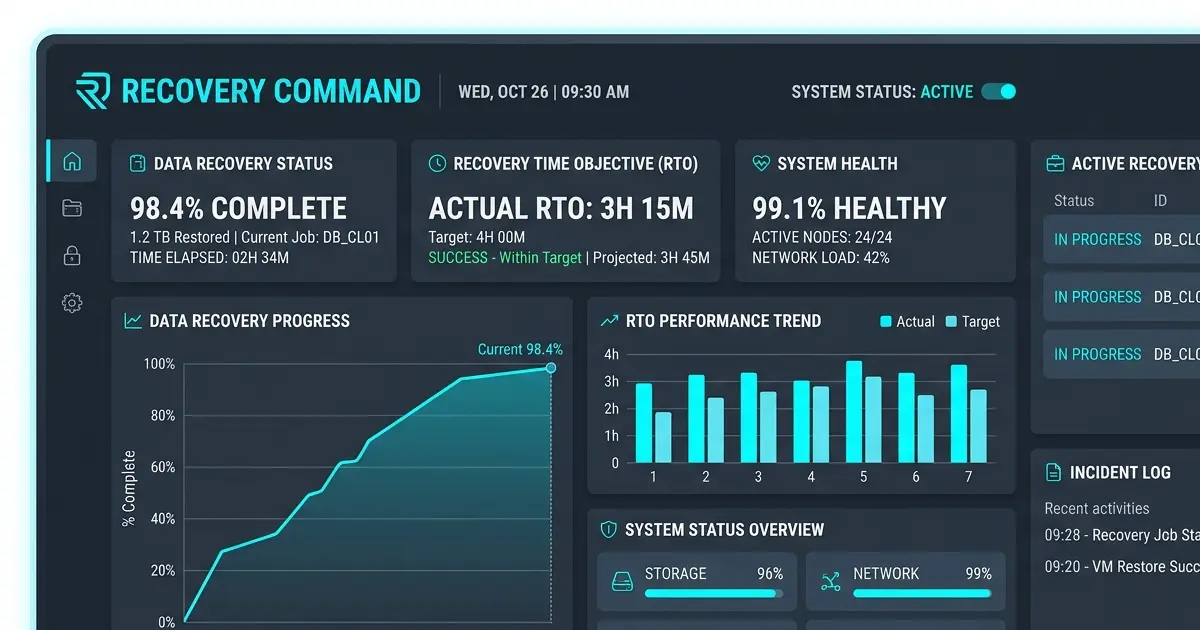
An IT disaster recovery plan is a documented, technically prescriptive blueprint that outlines the precise operational procedures required to restore hardware, enterprise applications, databases, and network connectivity following an unplanned disruption. While a business continuity plan manages the company’s human and operational posture, an IT disaster recovery plan (IT DRP) serves as the technical engine that recovers data integrity and compute capacity after a server crash, storage corruption, natural disaster, or cyber incident.
Core Metrics: Recovery Time Objective (RTO) vs. Recovery Point Objective (RPO)
An effective disaster recovery plan does not rely on guesswork or generic backup intervals. Instead, technical recovery strategies are dictated by two foundational metrics determined through a comprehensive Business Impact Analysis (BIA):
- Recovery Time Objective (RTO): The maximum acceptable duration of clock time that an application, network, or server can remain down before the business incurs unacceptable financial, legal, or operational damage. For instance, if an e-commerce checkout portal or transactional database has an RTO of 30 minutes, IT systems must be engineered with automatic failovers to prevent severe revenue loss.
- Recovery Point Objective (RPO): The maximum acceptable age of data files that can be lost from backup storage when an unexpected crash occurs. Measured in units of time, RPO determines backup frequency. An organization with an RPO of 24 hours backs up data once per night; however, if systems fail at 4:59 PM, all transactions, communications, and database entries created throughout that business day are permanently lost. For transactional databases, businesses require near-zero RPOs supported by continuous replication.
Tiered Recovery Architecture
Rather than applying uniform recovery targets across every operational system, organizations must categorize infrastructure into strategic priority tiers to mitigate the overall cost of IT downtime:
- Tier 1 (Mission-Critical): Core transactional databases, line-of-business operational applications, and identity/authentication directories. Recovery targets demand an RTO of under one hour and an RPO approaching near-zero.
- Tier 2 (Operational): Internal email systems, file-sharing repositories, and daily project management software. Recovery targets focus on an RTO of 4 to 8 hours and an RPO of 12 to 24 hours.
- Tier 3 (Archival and Non-Critical): Historical reporting engines, cold storage archives, and dormant development environments. Recovery targets can tolerate an RTO of 24 to 72 hours and an RPO extending across days or weeks.
The Shift from Reactive Break-Fix to Proactive Continuity
A critical threat to mid-market resilience is the lingering “break-fix” mindset. Under a reactive model, leadership waits for an infrastructure failure to occur before engaging external technical support. This reactive posture guarantees compounding downtime, high billable emergency fees, and the late discovery that local backups are corrupt, incomplete, or disabled by malware.
Organizations cannot rely on standard web vendors or agency hosts for critical system survival, as highlighted in this analysis of server vulnerability management. Proactive continuity, by contrast, treats infrastructure failure as a predictable operational certainty. Through continuous architectural testing and self-hosted data controls, proactive organizations establish engineered recovery pathways that restore mission-critical data within validated operational timelines.
How do data backup services and 24/7 proactive IT monitoring prevent catastrophic downtime?

Surviving major digital interruptions requires an enterprise-grade infrastructure built on two technical pillars: automated, isolated data backup services and continuous, 24/7 proactive IT monitoring.
Many SMBs mistakenly assume that consumer-tier file synchronization tools—such as basic OneDrive, Dropbox, or Google Drive folder mirroring—constitute an enterprise backup strategy. File synchronization utilities merely copy modifications in real time; if a local file is corrupted, accidentally deleted, or encrypted by ransomware, that damaged state is synchronized instantly to the cloud repository.
The 3-2-1-1 Backup Strategy and Immutable Storage
True enterprise cloud data backup requires adherence to the modernized 3-2-1-1 Rule:
- 3 Copies of Critical Data: Retain the production data set along with at least two separate backup copies.
- 2 Different Storage Media Formats: Store data on distinct media types (for example, high-performance local network-attached storage and remote cloud repositories) to prevent simultaneous medium failure.
- 1 Copy Offsite: Maintain at least one backup replica in a geographically separated, climate-controlled data center to protect against localized utility outages, physical destruction, or regional grid failures.
- 1 Copy Immutable or Air-Gapped: Ensure at least one backup copy is write-locked against cryptographic modification.
Modern ransomware strains explicitly target secondary network paths, searching for connected backup storage to delete, corrupt, or encrypt snapshots before executing on the primary host. Immutable cloud data backup neutralizes this attack vector using Write Once, Read Many (WORM) storage architecture.
Once an immutable snapshot is written, it is cryptographically locked for a user-defined retention period (such as 30, 60, or 90 days). During this period, the snapshot cannot be overwritten, encrypted, or deleted by any actor—including compromised root administrator accounts. If a catastrophic incident occurs, technical teams can wipe the affected environments and execute a rapid clean-slate restoration from a verified, uncompromised snapshot.
Proving Recovery Viability Through Scheduled Restoration Drills
A green status indicator on an administrative backup panel does not guarantee that data can successfully boot into operational virtual environments. Backups are only as reliable as their last successful recovery drill. Routine disaster recovery simulations—including bare-metal restores, virtual machine failover boots, and database table integrity verifications—must be executed systematically to ensure that real-world restoration performance aligns with assigned RTO and RPO benchmarks.
Preemptive Protection Through 24/7 Proactive Monitoring
Waiting for end users to report application slowdowns or server connection drops is a critical operational failure. Continuous, automated monitoring identifies pre-failure conditions before systems cascade into catastrophic outages:
- Storage Capacity Thresholds: Enterprise database engines experience immediate corruption if disk volume hits 100% capacity. Automated monitoring tools detect abnormal disk growth trends, alerting engineers at 80% and 90% thresholds to avoid systemic freezes.
- Anomalous Behavioral Detection: Proactive systems monitor telemetry for sudden CPU spikes, continuous failed login attempts, unauthorized permission alterations, or mass file modification activity that indicates active ransomware staging.
- API and Cloud Connector Health Checks: Automated synthetic transactions continuously ping third-party cloud integrations, ensuring that dropped connections between accounting, ERP, and payment networks are addressed immediately.
- Triage Escalation: Integrated monitoring platforms route priority-one technical alerts directly to designated on-call network engineers, bypassing passive ticket queues to remediate vulnerabilities before staff report for the business day.
Maintaining round-the-clock technical operations in-house requires substantial capital expenditures. To access enterprise monitoring stacks and dedicated engineering teams without unsustainable payroll overhead, growing organizations frequently leverage specialized managed IT services and outsourced IT support. Reviewing modern industry IT insights demonstrates that proactive infrastructure management significantly reduces downtime-related balance sheet exposure.
Comprehensive business continuity and IT disaster recovery planning are no longer optional safeguards reserved for Fortune 500 enterprises; they are critical operational necessities for SMB survival. By replacing reactive habits with enterprise-grade data backup services and 24/7 proactive IT monitoring, organizations can successfully insulate themselves against unpredictable global tech outages. Partnering with dedicated IT experts ensures your business remains resilient, secure, and operational no matter what digital disruptions occur next.
At Lyttix, we specialize in comprehensive Business Continuity, Disaster Recovery, 24/7 Proactive IT Monitoring, and Enterprise Data Backup Services designed specifically for small and mid-sized businesses. Our expert team builds resilient, custom IT infrastructures that protect your critical data from cyber threats and unexpected outages, ensuring your operations remain uninterrupted around the clock. Partner with us to transition from reactive troubleshooting to total digital resilience.
Don’t wait for the next global tech outage to bring your operations to a halt. Contact Lyttix Managed IT today for a comprehensive disaster recovery assessment and secure your business with our enterprise-grade backup solutions.